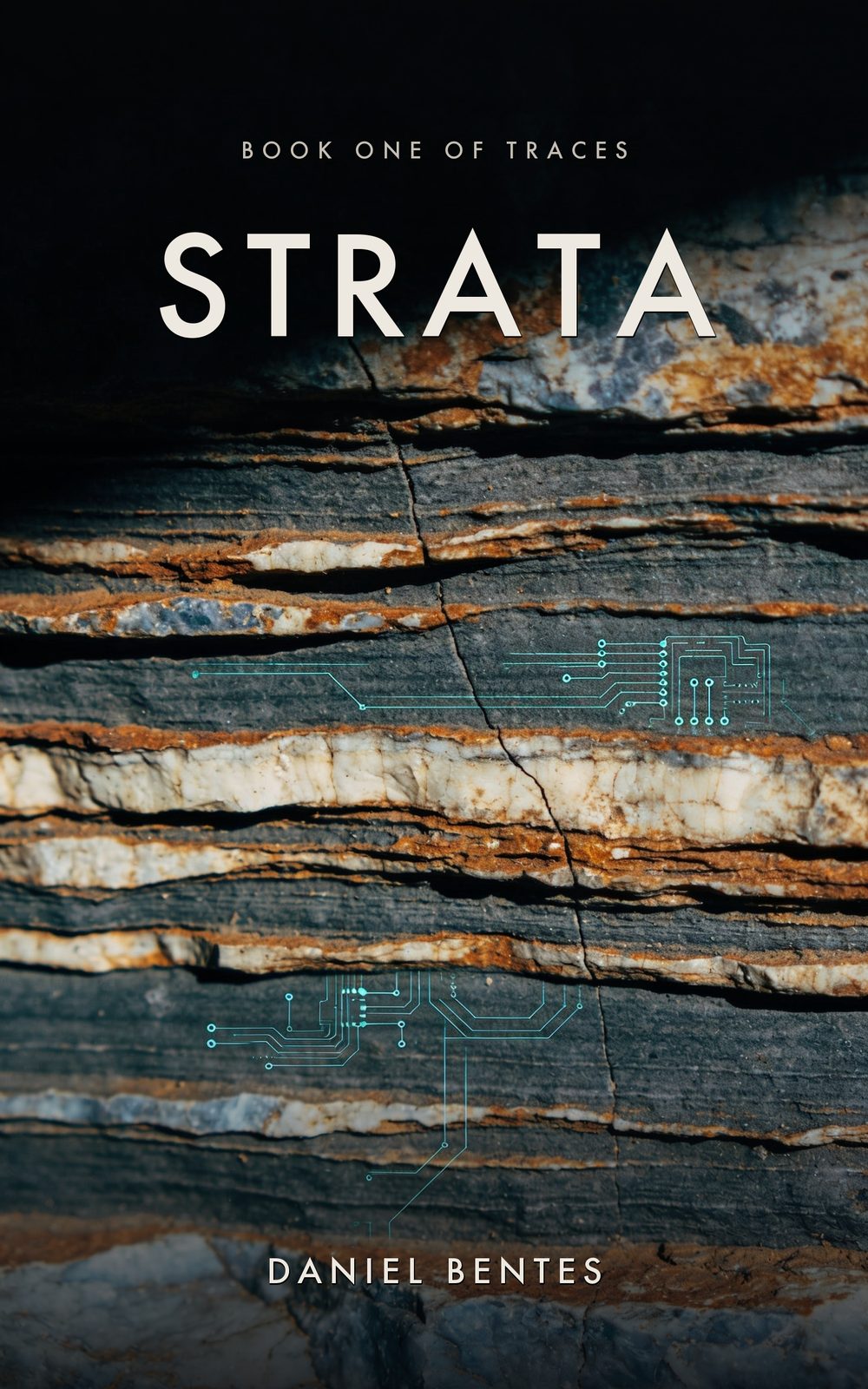
Traces · Book One
Strata
Everyone else forgets. He remembers — and remembering is what gets you deleted.
Kindle and paperback available now · remaining formats land as they're ready
- Ebook Kindle — live now · Apple Books · Kobo
- Paperback 6×9 print — live now
- Audiobook digital narration
- Direct, DRM-free EPUB + PDF
Kindle and paperback are live now. Remaining formats land as they're ready — this page updates as each one does.
What it's about
"You're misremembering."
Samuel Cole has been told it his whole life — by his parents, by his doctors, by his sister — every time he tries to describe the neighbor who taught him to see. A man no one else on earth remembers.
He is a geologist now. He reads the earth in layers and stakes his name on what it tells him. Stone does not lie to him. He cannot say the same of himself.
The world is a record, and something very far ahead of us is editing it — unmaking the people who threaten what is coming, so completely that no one who is left could miss them. A few can still feel the hole. And the record's oldest defense is not secrecy. It is the habit it has taught every witness: to disbelieve your own eyes.
Samuel stops disbelieving. And the moment he looks straight at it, he finds the rule beneath everything: the record erases what it notices — and nothing makes a person more noticeable than being loved.
Which puts Hannah on the list. His sister is marked for nothing she has done. Only for being loved by him.
To reach her, Samuel will have to go down — through a society that has served the editors for millennia and a resistance that has fought them for three centuries; from a labyrinth beneath the pyramids at Giza to a chamber in the Andes, each layer older than the one above it, until he reaches the seam beneath them all and finds something that was here first.
And he will have to face the one thing he has never questioned: that he protects the people he loves by controlling what they are allowed to see.
Which is precisely what the record does.
Which is what he has been doing to Hannah since they were children.
An excerpt
She would remember the sound of his laugh for forty-six years, long after everyone else had forgotten he existed.
That autumn afternoon, the laugh rang out from his room at the end of the hall. Sudden, surprised, delighted by something in the notebook spread across his knees. Chiyo stopped outside his door, caught by the sound. Kenji's laugh had always been like that: it arrived without warning and left you warmer than before.
"Chi-chan." He looked up and saw her hovering. "Come look."
She padded across the tatami, the grass-scent rising with each step, and settled beside him. Golden light slanted through the paper screens, catching dust motes and casting long shadows across his desk. Posters of Western rock bands covered the wall behind his futon, names she couldn't read, faces she didn't recognize, but Kenji loved them. On his desk, propped against a stack of books, sat a photograph in a wooden frame: the four of them at last year's festival, Kenji's arm around her shoulder, both of them squinting into the sun. Outside, the maple leaves had turned, red and gold, the colors of festival lanterns.
"What is it?" she asked.
The notebook was spiral-bound, Western-style, its pages covered in Kenji's precise handwriting. Diagrams connected names and dates with arrows. Questions clustered in the margins, circled and starred. She recognized their grandfather's name. Their great-grandmother's. Names she'd seen on the shrine but never thought to question.
"I've been looking through the family archives," Kenji said. His voice had dropped, though their parents were downstairs. "Father's study. The locked cabinet."
"You're not supposed to—"
"I know." His eyes were bright. Fifteen years old and already wearing that expression she'd come to recognize: the look he got when he'd found something worth finding. "Chi-chan, there are records going back centuries. Our family. Other families. All connected."
"Connected to what?"
He turned a page. More diagrams. More questions. In the center of one page, a single word circled so many times the paper had torn: Cultivation.
"That's the thing." He leaned closer, voice dropping. "No one will say. But I think I'm close." He closed the notebook and met her eyes. "Tomorrow. I'll show you everything tomorrow. I just need to check one more thing."
— from the Prologue, "The Last Brother"
How this book was made
Strata was written with artificial intelligence. Not as a gimmick, not as a shortcut, and not quietly.
The prose was drafted by large language models working under my direction, inside a system I built called the Epic Fiction Framework. Then I edited it, cut it, argued with it, and rewrote it across more passes than I want to count. The plain word for that is AI-generated. I am not going to dress it up, and I would rather tell you than have you find out.
But that sentence, on its own, is a bad description of what actually happened.
The machine did not decide what this book is about. It did not invent the premise, or the world, or the people in it, or what any of it means. Those came out of years of reading and thinking, and a great many bad ideas discarded before the good ones surfaced. The story existed before a single word of prose was generated — as a bible of a hundred documents: world, character, plot, theme, and rule.
What the machine did was write sentences. That is not nothing; sentences are what a novel is made of. But it wrote them toward something, and the something was already there. Some chapters survived largely as drafted. Many were rewritten to the studs. A few were thrown out and rebuilt, because what came back was competent and correct and completely dead, and the only cure for that is a person who can feel it.
I do not think the interesting question is whether a machine touched the manuscript. I think it is whether anyone was home — whether there is a person in here with something to say, who made a thousand choices you cannot see, and who is accountable for the result.
I was home for all of it. If Strata moves you, that is not the machine's doing. If it fails you, that is not the machine's fault. It is mine either way.
There is a longer version of this note at the back of the book. The full technical account — the bible, the agents, the validation passes, and the things that went wrong — is at loreon.ink/strata.
— Daniel Bentes, Oslo